
Introduction
A single-level index is an ordered file, and searching it means a binary search:
The insight of the multilevel index is that the index is a sorted file with a key field, so it can be indexed exactly like the data file was — and each level shrinks the search by the blocking factor rather than by half.
Multilevel Indexes
Definition
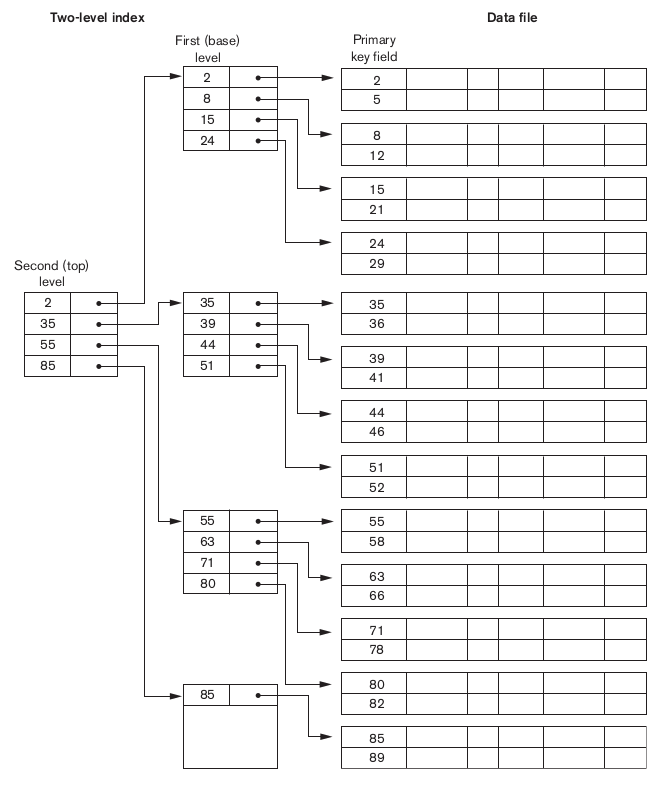
A multilevel index treats an index file as an ordered file and builds a primary index over it. The original index is the first (base) level; the index over it is the second level; the process repeats until a level fits in one block, the top level.
Every level above the first is a primary index over the level below: sparse, one entry per block, using block anchors. This is possible even when the base level is a dense secondary index, because the base level is physically ordered on its search key and its key values are unique (or made unique by indirection).
Fan-out
The number of entries per index block plays the role that "2" plays in binary search:
Definition
The fan-out
With
and the search cost is
Because
Applying it to the running example
The 30 000-record file of the previous note, with a dense secondary index of
| Level | Entries | Blocks |
|---|---|---|
| 1 (base, dense) | 30 000 | |
| 2 | 442 | |
| 3 (top) | 7 |
Against 10 for the single-level version, and 1 500 for a linear scan.
The same treatment of the primary index (45 blocks, 3 000 base entries) gives a second level of
| Access path | Block accesses |
|---|---|
| Linear search | 1 500 |
| Binary search on ordering field | 12 |
| Single-level secondary index | 10 |
| Multilevel secondary index | 4 |
| Multilevel primary index | 3 |
Why the numbers stop shrinking
Each level costs one access and divides the remaining entries by
ISAM and the Problem with Static Indexes
The multilevel index described above is static: the levels were computed once, from a file of a known size, and every block is full.
This is the classic ISAM (Indexed Sequential Access Method) organization, and it breaks down as soon as the file changes:
- Insertion into a full index block cannot simply shift entries — shifting propagates through the whole level, and changing a block anchor propagates upward to every level above.
- The practical workaround is an overflow chain per block: new entries that do not fit go into overflow blocks linked to their home block.
- Search now costs
, and the chains grow without bound. - Deletions leave empty space that only reorganization reclaims.
The real cost of overflow chains
An ISAM index degrades unevenly. A key range that receives many inserts grows a long chain while the rest of the index stays pristine, so average search cost stays deceptively good while the hot part of the file gets slow. Restoring performance requires a full reorganization — rebuilding every level offline.
What is needed is an index that leaves space for growth inside each block and that grows or shrinks one node at a time, keeping itself balanced without reorganization. That is a dynamic multilevel index, and it is built on trees.
Trees as Index Structures
Tree terminology
A tree is made of nodes. Each node except the root has one parent and zero or more child nodes; a node with no children is a leaf, and a node with children is an internal node. The level of a node is its distance from the root (root is level 0), and the tree's height is the number of levels.
The mapping to indexes is direct: one node = one disk block, so the height of the tree is the number of block accesses per search, and a fat node (many children) is exactly a high fan-out.
Search trees
Definition
A search tree of order
with
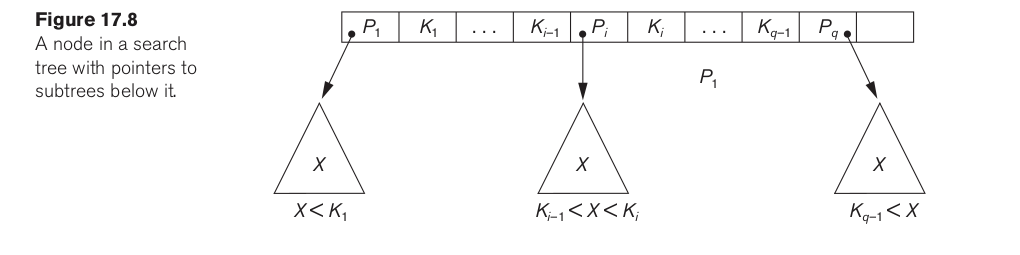
Searching for value
Why a plain search tree is not enough
Nothing in the definition controls the tree's shape:
| Problem | Consequence |
|---|---|
| The tree can become unbalanced | Some leaves sit far deeper than others, so search cost varies wildly and can degenerate toward |
| Nodes may be nearly empty | A node is a disk block; a node holding 2 of 68 possible entries wastes most of a block access |
| Deletion is awkward | Removing a value from an internal node requires reorganizing subtrees, with no rule guaranteeing the result stays usable |
The fix is to impose two extra constraints — a minimum occupancy for every node, and the requirement that all leaves be at the same level. A search tree with those constraints is a B-tree, the subject of the next note.