
Introduction
The previous chapter ended with an uncomfortable number: finding one record in a 3 000-block heap file costs about 1 500 block accesses, and even a sorted file only gets that down to 12 — and only when the search is on the ordering field.
Indexes are additional access structures built on top of a file to speed up retrieval on fields that the file's own organization does not help with.
Definition
An index is an auxiliary file whose entries are pairs
sorted on the field value, so that a search on that field can be answered by searching the (much smaller) index instead of the data file.
The analogy is the index at the back of a book: it is much thinner than the book, it is sorted, and each entry tells you which page to turn to. Two properties make it work, and both matter for database indexes too:
- the index is smaller than the data — an entry holds one field value and a pointer, not a whole record, so far more entries fit in a block;
- the index is ordered, so binary search applies even when the data file is unordered.
An index is defined on a single field of the file, called the indexing field (or indexing attribute). A file can have several indexes, on different fields, all at the same time.
Dense vs. sparse
Every index in this note is one of two kinds, and the distinction decides its size:
Definition
A dense index has an index entry for every record (every search key value) in the data file.
A sparse index has entries for only some of the values — typically one per block of the data file.
A sparse index is only possible when the data file is physically ordered on the indexing field: if the file is sorted, an entry pointing at a block is enough, because everything between two consecutive index entries must live in the blocks between their pointers. On an unordered field, the records with a given value are scattered, so nothing but a dense index will do.
The running example
All the cost numbers in this note come from one file, so the index types can be compared directly.
| Parameter | Value |
|---|---|
| Records | 30 000 |
| Block size | 1 024 bytes |
| Record size | 100 bytes, fixed length, unspanned |
| Blocking factor | 10 records/block |
| File size | 3 000 blocks |
The file is ordered on the key field Ssn (9 bytes). A block pointer
Without any index: linear search averages Ssn costs
Primary Index
Definition
A primary index is an ordered file whose records are of fixed length with two fields: the value of the ordering key field of the data file, and a pointer to a disk block. There is one index entry per block of the data file.
The value stored in entry
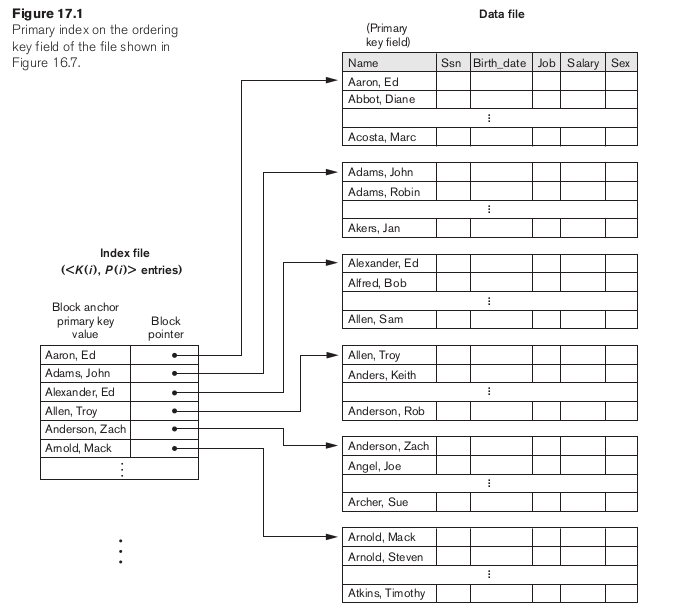
A primary index is therefore:
- sparse — one entry per block, not per record;
- available on at most one field per file, since a file can be physically ordered only one way;
- dependent on the ordering field being a key (unique values).
Why it is small
The number of entries
A binary search on the index costs
Reading the entry that "isn't there"
Searching a primary index does not look for an exact match. To find record
The insertion problem
A primary index inherits the sorted file's weakness and adds one of its own: inserting a record both shifts records in the data file and may change a block anchor, forcing index entries to change too.
The standard remedies are the ones from sorted files: an overflow file of unsorted new records merged in periodically, or a linked list of overflow records hanging off each block. Deletion again uses deletion markers, so the index only needs updating when a block anchor disappears.
Clustering Index
Definition
A clustering index is used when the data file is physically ordered on a non-key field — a field with duplicate values, called the clustering field. It has one entry per distinct value of that field, pointing to the first block that contains a record with that value.
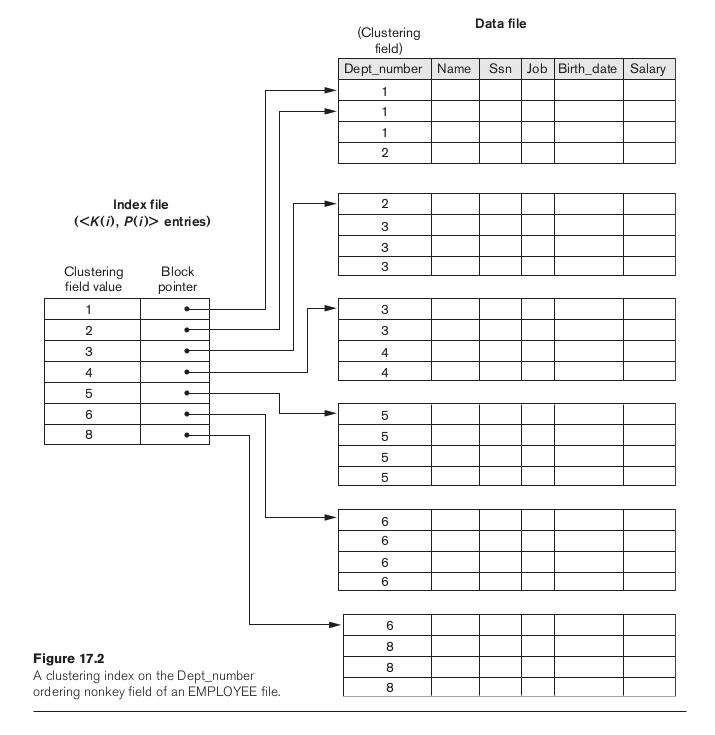
It is also sparse — entries exist per distinct value, not per record — and, like the primary index, a file can have at most one, because it depends on physical ordering.
Suppose the 30 000-record file is instead ordered on Dept_number (4 bytes) with 1 000 distinct departments:
That locates the first block of the matching department; the remaining records of that department follow in the next blocks and are read sequentially.
Blocks reserved per value
Insertion is still expensive, because records must stay grouped by value. A common fix is to give each distinct value its own block (or chain of blocks), linked by pointers. Insertion then only touches the chain for that value, and the index entry never has to move — at the cost of wasting space in partially filled blocks.
Secondary Index
Definition
A secondary index is an ordered file on a field that is not the physical ordering field of the data file. The indexing field is called a secondary key.
This is the index type that a file can have many of — one for every field that queries filter on. Because the data file is not ordered on the field, the index cannot be sparse.
Case 1 — the field is a key
One entry per record, pointing to the record (or to its block): a dense index, sorted on the secondary key value.
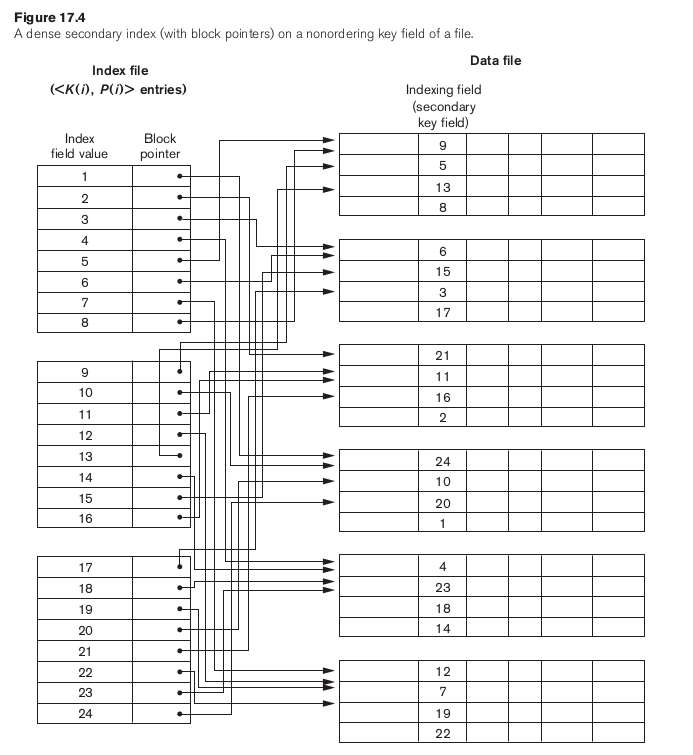
For the running example, a secondary index on a 9-byte key field:
Compare that with
A secondary index is much bigger than a primary one
442 blocks against 45, for the same file and the same field width. The difference is entirely density: one entry per record instead of one per block. This is why a single-level secondary index is rarely enough, and why multilevel indexes matter most here.
Case 2 — the field is not a key
Now several records share a value, and the index has to point to all of them. Three options:
| Option | How it works | Cost |
|---|---|---|
| Duplicate entries | One index entry per record, with the value repeated | Index no longer has unique keys; largest of the three |
| Variable-length entries | One entry per distinct value, holding a list of record pointers | Variable-length records in the index — awkward to search and update |
| Level of indirection (usual choice) | One entry per distinct value, pointing to a block of record pointers; that block lists every record with the value | Index stays fixed-length and dense on distinct values; costs one extra block access |
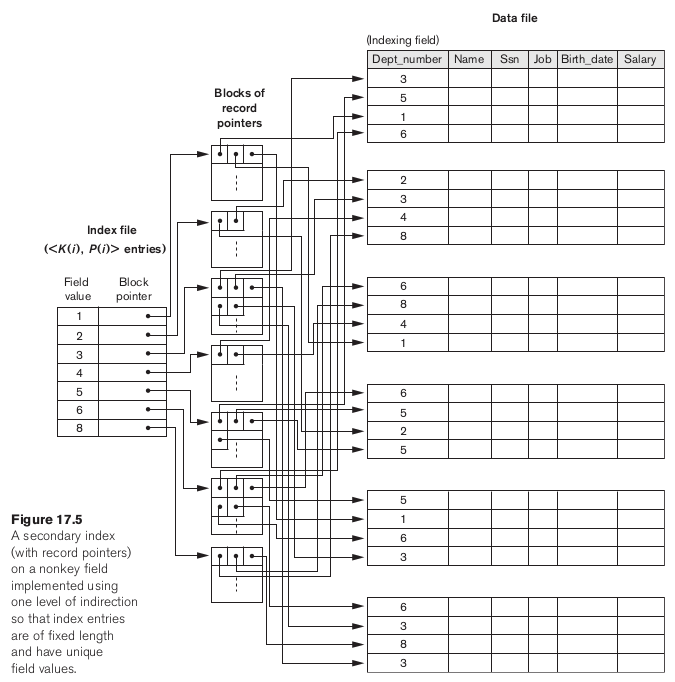
The indirection option also makes retrieval of all matching records convenient: read one pointer block, then fetch exactly the records needed — no scanning.
Comparison
| Ordering field? | Key field? | Dense/Sparse | Number of entries | Per file | |
|---|---|---|---|---|---|
| Primary index | Yes | Yes | Sparse | One per block | At most 1 |
| Clustering index | Yes | No | Sparse | One per distinct value | At most 1 |
| Secondary index (key) | No | Yes | Dense | One per record | Many |
| Secondary index (non-key) | No | No | Dense on values | One per distinct value (with indirection) | Many |
Cost for the running example, all on the same 3 000-block file:
| Access path | Block accesses |
|---|---|
| Linear search, no index | 1 500 |
| Binary search on ordering field | 12 |
| Primary index (45 blocks) | 7 |
| Clustering index (10 blocks) | 5 |
| Secondary index on a key (442 blocks) | 10 |
What is still wrong
Every number above comes from a binary search on the index file, which is itself just an ordered file — so the index has exactly the problems the data file had:
The obvious move is to apply the idea again and index the index. That is the multilevel index, and it is the subject of the next note.